Every dividend you have been paid, on the record
Dividend income is easy to lose track of — a few pounds at a time, across dozens of holdings, over several years. Tracker 212 counts every payment from your own Trading 212 history and shows what it adds up to, per holding and across the whole portfolio.


Income is counted beside your profit, not inside it
Your lifetime profit and loss is one thing: what your trading did, realised and unrealised combined. A dividend is not that — it is money the company handed you for holding the shares, and folding it into a trading result would flatter the trading.
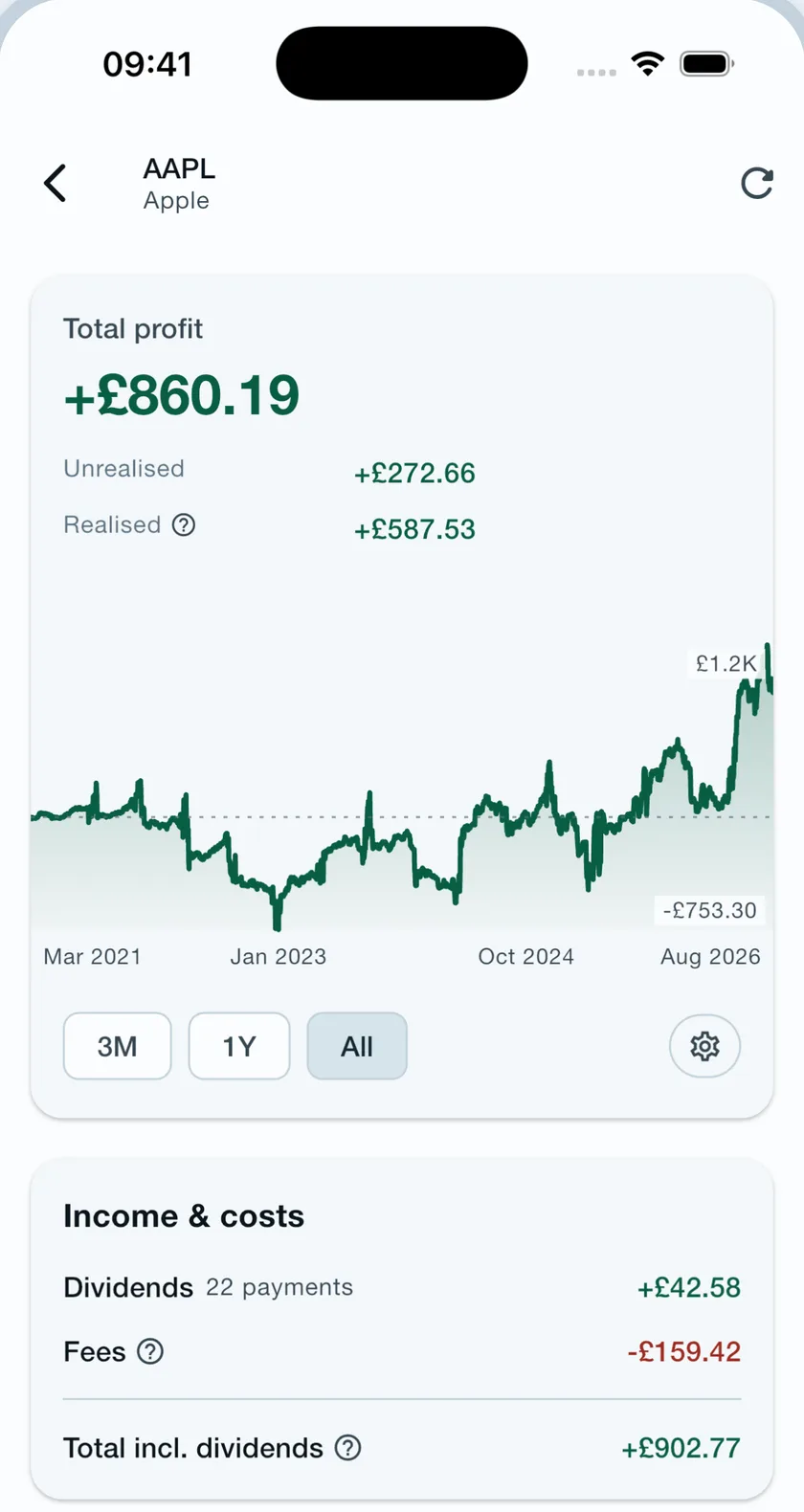
So the app keeps the two apart and prints both. A holding’s card states the capital result first; below it the payments are counted with their own total, and the card closes on what the position did once that income is added:
- Total profitrealised and unrealised
- +£860.19
- Dividendsacross 22 payments
- +£42.58
- Total including dividendsstated separately, never merged
- +£902.77
One holding’s income, beside its capital result. The bottom line is the top two added together — +£42.58 and +£902.77 are the same two figures the phone above prints on the card itself — and the app does that addition in public rather than quietly upstream, which is the only way you can read a position both with and without the income it paid you.
Twenty-two payments of a few pounds each is the kind of number nobody adds up by hand, which is exactly why it is worth having counted for you. A holding you think of as a small position can turn out to have been paying you all along.
Every payment your whole portfolio has made you
Across the whole book those payments are totalled on one card, with interest beside them: what your holdings paid you, and what your uninvested cash earned, both lifetime and both in your chosen portfolio currency. Each payment is converted at the rate that applied on the day it landed rather than today’s.
The app files income and costs together, so the same card carries what the book paid out in charges. It is the one figure here that is money leaving rather than arriving, and it has a page of its own.
- Dividends
- £1,029.26
- Interest
- £444.85
- Fees
- −£645.24
Tap that dividend total and it opens as a screen of its own: every asset that has ever paid you, ranked by what it paid, each row carrying the number of payments behind its figure. You can rank by that count instead — which holding pays most often is a different question from which pays the most, and both are worth asking.
See the payments against the price
A holding’s chart can draw its dividends on the line as well as its trades, so a payment is a mark where it happened rather than a row in a list somewhere else. A day that both traded and paid keeps its trade marker and leaves the payment to the history below it, which is where the full truth of a day lives.
The overlay is off until you ask for it and then stays on for every asset, because wanting payments drawn is a way of reading charts rather than a fact about one holding.
Frequently asked questions
How does Tracker 212 know about my dividends?
They come from your own records. Dividend payments are part of the history the app imports — whether you connect a read-only API key or import CSV exports — so every payment is counted from the same ledger your trades come from.
If I import overlapping exports, will a dividend be counted twice?
No. Trading 212 gives an order its own id but does not give one to a dividend, so each payment is identified by its date, its amount and the holding that paid it. Import the same period twice and the second copy is recognised and skipped. Two genuinely separate payments that landed on the same day for the same amount are kept as two, because that is what they are.
Does it track interest on uninvested cash too?
Yes, beside your dividends rather than inside them. Interest is paid on cash, not on a holding, so it belongs to no ticker and is never attributed to one — it is counted on the account-wide income card, where what your cash earned is not lost among your trades.
Can I see dividends for one holding on its own?
Yes. Open any asset and its income and costs are stated together: how many dividend payments it has paid, what they add up to, what it has cost you in fees, and the total including dividends.
Are dividends included in my profit and loss?
No — and that is deliberate. Your lifetime figure is realised and unrealised gains combined; dividends and interest are counted alongside it rather than folded into it. Each asset states both, so you can see what a holding did on price alone and what it did once the income it paid you is added.
See what your holdings have paid you.
Every dividend and every interest payment, counted out of your own export.
Profit & loss explained
Realised, unrealised, why a deposit is not performance — and the moments hiding in your profit line.
Read more →Portfolio tracker
Every position you have ever held, the shape of the book as a heat map, and any past date you like.
Read more →CSV export
What a Trading 212 CSV export actually contains, and how to turn it into your real lifetime profit and loss.
Read more →