What every charge actually cost you
Fees arrive a few pence at a time and nobody itemises them for you. Tracker 212 reads every charge recorded against your Trading 212 transactions and totals them — per asset, per charge, cumulative since your first trade.


Ranked by what each one cost you
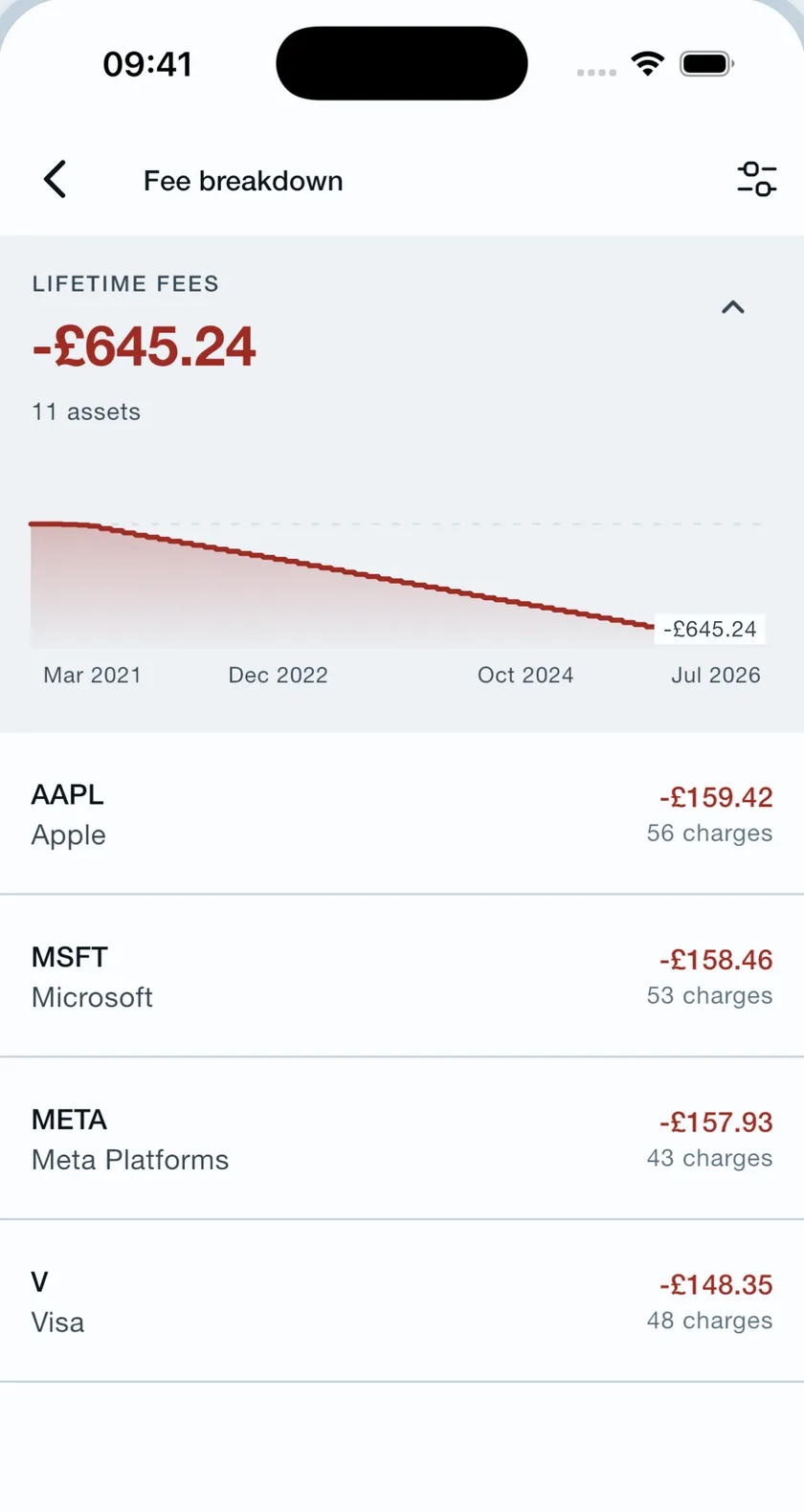
Under the lifetime total, every asset that has cost you anything is ranked by what it cost, with the number of separate charges beside each figure.
That count is not decoration. A holding charged once for a large amount and a holding charged two hundred times for small ones reach the same figure by completely different habits, and only one of them is something you can change.
A charge that belongs to no holding still counts towards the lifetime figure — it simply has no row to sit in. Rather than let the rows quietly fail to add up, the screen says how much of the total they do not account for.
What each position cost to own
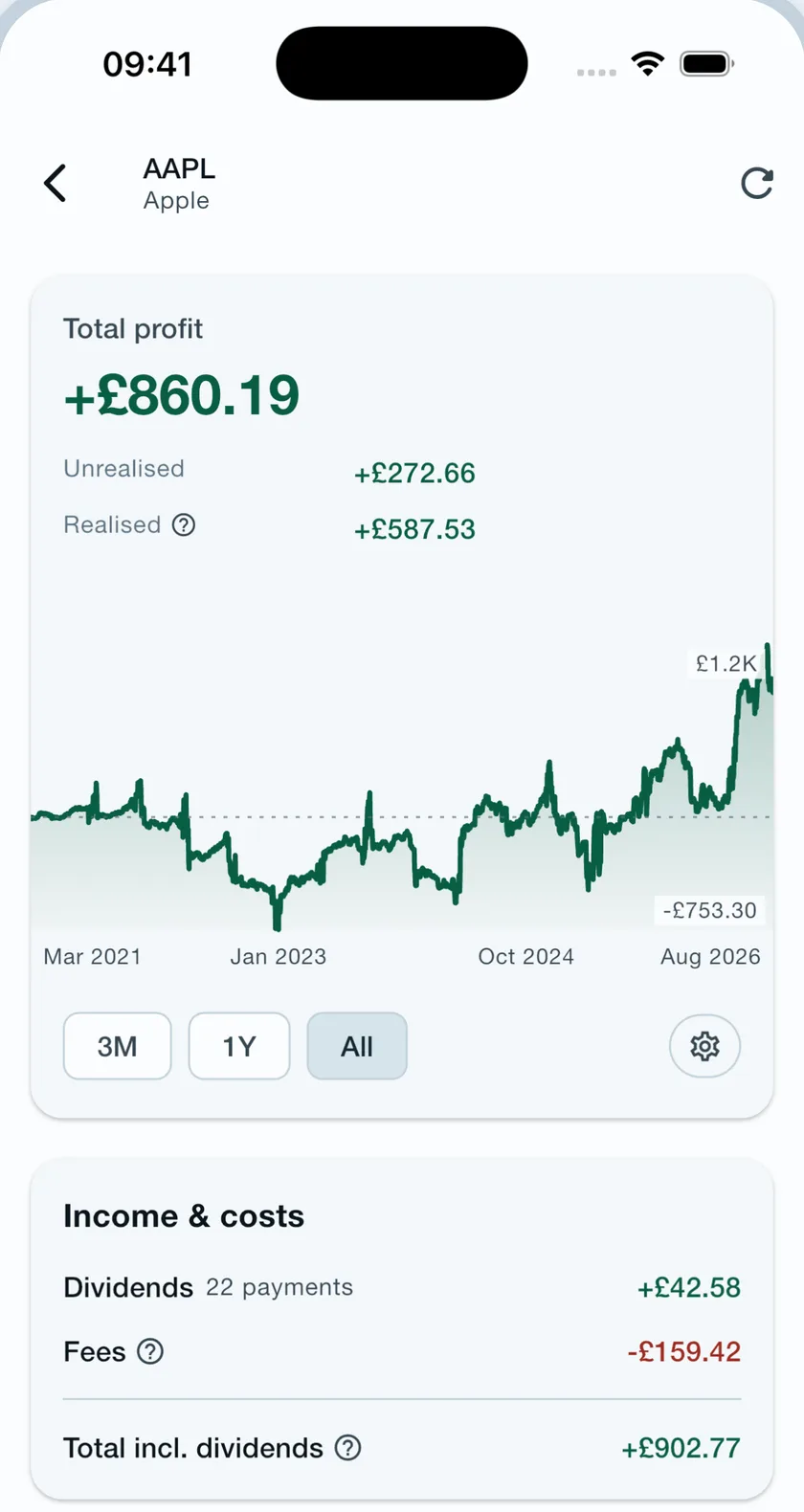
Open any holding and it carries its own fee figure — this one has cost −£159.42 to own — sitting on the same card as the income it has paid, so a position’s charges are read at the scale you actually chose them at rather than as a slice of a portfolio total. The green figure at the foot of that card is not a fee calculation: it is what the holding has done with its dividends counted in, and these charges are already inside it.
One column, two kinds of money going out: an order’s own charge and the tax withheld from a payment land in the same total, because both are money the holding cost you. A position can be up on paper and still have quietly given a chunk of that back — this is where you find out.
You have already paid all of this
Nothing on this page is a new deduction. Every order Trading 212 exports carries a total the charge has already come out of, so your profit figures reflect your fees whether or not anybody adds them up. Taking them off again would be counting the same money twice, and the app does not do it.
What the app does instead is gather them back up and name them. The lifetime figure is not what fees will cost you — it is what they have cost you, spent, in the past, in amounts too small to have registered at the time.
Which is why the curve under the total only ever goes one way. It runs from −£0.48 to −£645.24 and never turns, because a fee is the one figure in this app that cannot recover. Every other line on your portfolio can come back; this one is a ratchet.
The uncomfortable part: a single charge is never worth reading, which is precisely why nobody reads them. The number only exists oncesomebody adds up every one of them since your first trade, and until then it is not small — it is invisible.
Frequently asked questions
Which fees does Tracker 212 count?
The charges recorded against your own transactions. In a Trading 212 export those arrive in their own columns — currency conversion fee, transaction fee, Finra fee and stamp duty reserve tax among them — and each is read and totalled rather than rounded away. Every charge column has a currency column of its own, and the two are matched by name rather than by position, because at least one year of exports lists the currencies in a different order from the charges they belong to.
Why do my fees look higher than I expected?
Because they are counted across your whole history rather than per trade. Individually a conversion fee is small; the same fee on a few hundred orders over several years is a number worth seeing. Nothing here is an estimate — every figure is the sum of charges already recorded against your transactions.
Can I see which holdings cost me the most?
Yes — the lifetime figure opens into a ranked list, most expensive holding first. The rows are the same positions you meet everywhere else in the app, so what a holding has cost you can be read straight against what it has made you.
Is tax withheld from a dividend counted here too?
Yes. Withholding on a payment is recorded against the holding just as an order’s own charge is, and one column carries both — so a position’s fee figure is never only what you were charged to trade it.
Find out what the fees really cost.
Every charge on your record, added up for the first time.
Profit & loss explained
Realised, unrealised, why a deposit is not performance — and the moments hiding in your profit line.
Read more →Spreadsheet vs app
What a spreadsheet gets right about your portfolio — and the six things it quietly gets wrong.
Read more →Portfolio tracker
Every position you have ever held, the shape of the book as a heat map, and any past date you like.
Read more →