
What your profit and loss is actually made of
“How much have I made?” has a longer answer than it looks. Realised against unrealised, what counts as performance and what is just money moving, where fees already sit, and how to compare yourself with an index without flattering the result.


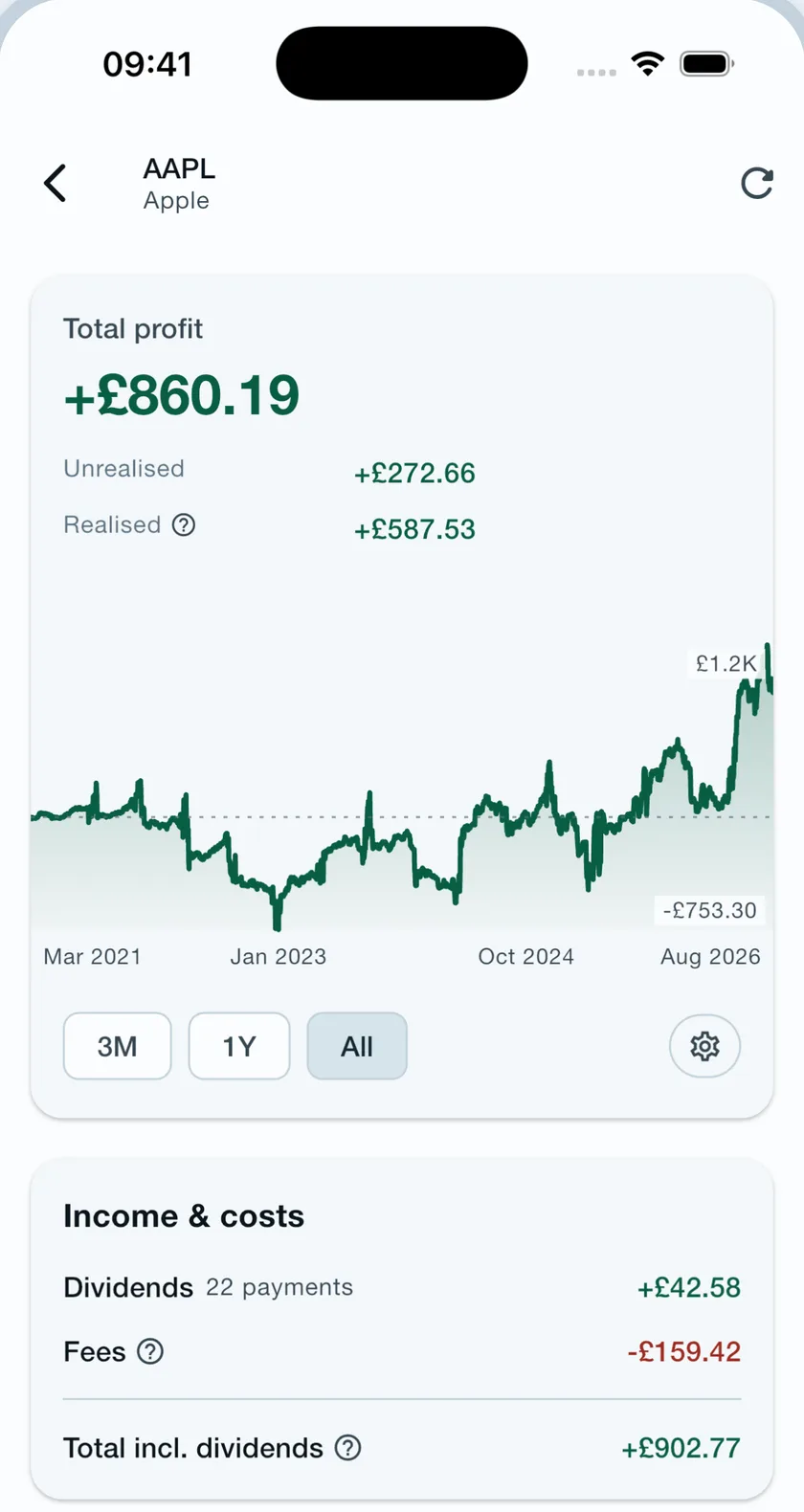
Realised and unrealised are different questions
Realised is settled: you sold, and the result is banked. It cannot move again. Unrealised is the paper position — what your open holdings are up or down right now, a number that will be different tomorrow.
Together they are your lifetime result. Apart, they answer something more useful: how much of what you are up have you actually taken, and how much is still riding on the market’s opinion this morning.
Which shares a sale is priced against decides what “realised” even means. Here every sale is priced against the cost average as it stood on the day it happened, so the banked figure is the one a statement would give you for that day. Re-average the whole history instead and the number moves after the fact: a holding you sold out of and bought back later hands you a loss you banked years ago, charged a second time against shares you did not own at the time.
What counts as performance
This is the distinction most homemade calculations get wrong, and it is the one that decides whether your return means anything:
- Sale resultsperformance
- Price movement on open positionsperformance
- Dividendsperformance
- Interest on cashperformance
- Fees and chargesperformance
- Depositsnot performance
- Withdrawalsnot performance
- Currency conversionsnot performance
Money your portfolio earned or was charged is performance. Money you moved is not. Get that line in the wrong place and a good month of deposits looks like a good month of investing.
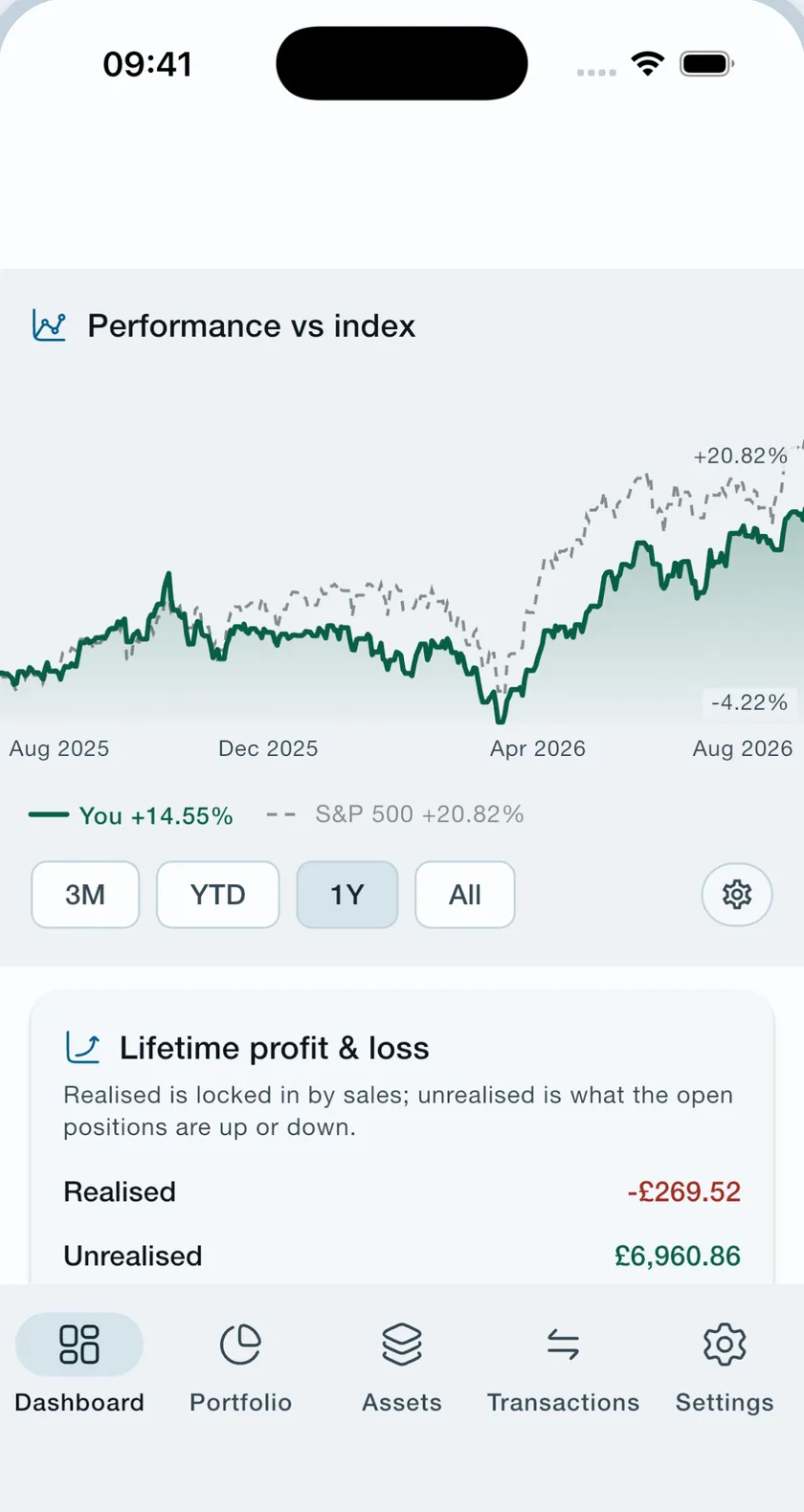
A fair comparison, or none at all
Your return and the index are both rebased to zero on the same day and drawn together, so what you are reading is genuinely the same question asked of both. Deposits contribute nothing on arrival, which is precisely what stops a month of paying in from masquerading as a month of performance.
You can compare against the S&P 500, NASDAQ 100, Dow Jones, FTSE 100, DAX, EURO STOXX 50 or Nikkei 225. Uninvested cash stays in the base rather than being quietly excluded — if idle cash dragged on your return, that is part of the answer.
The legend states each line’s own figure and deliberately stops there. The gap between them is yours to draw.
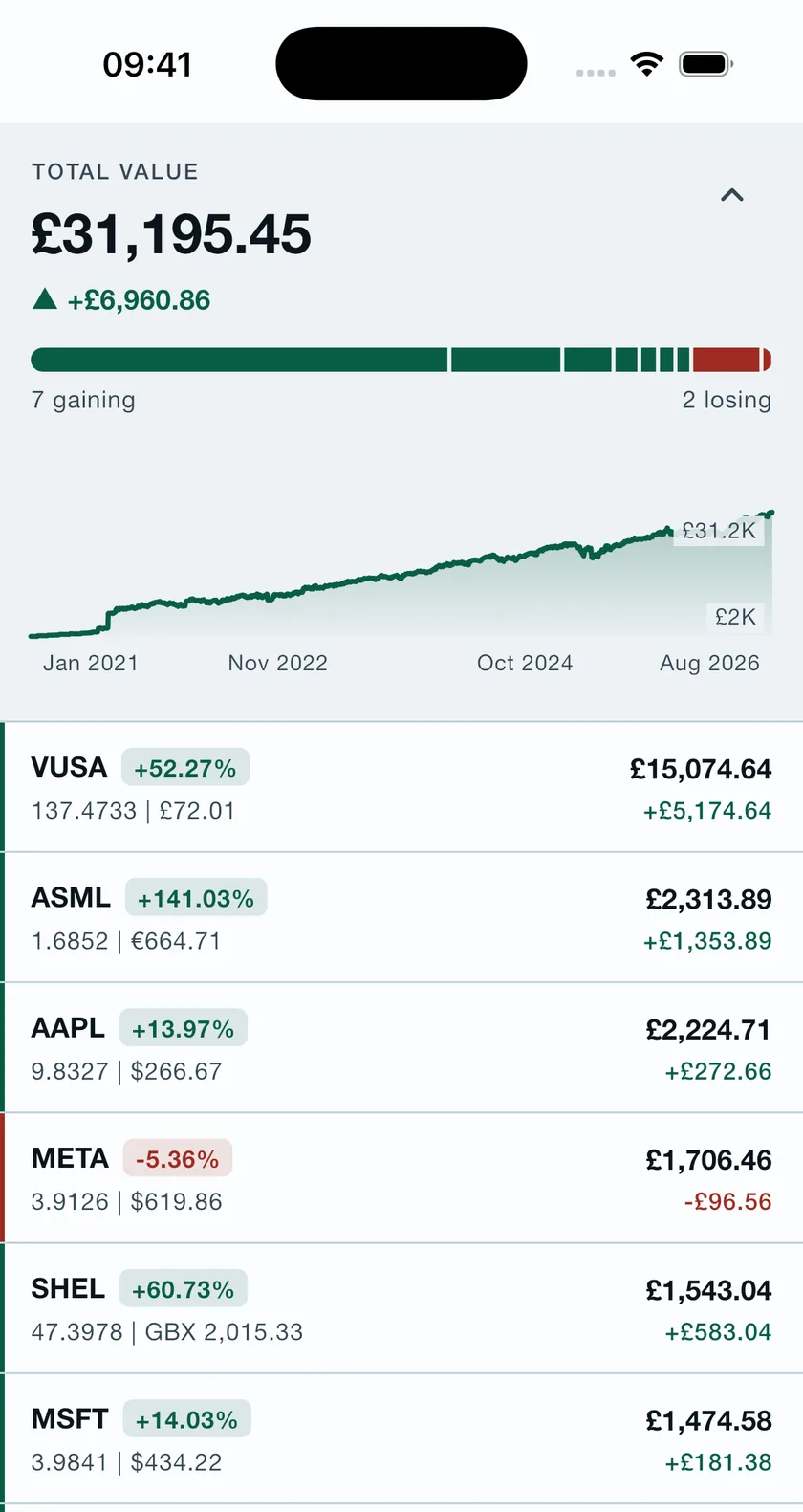
What is up, what is down, and what it is not sure about
Seven gaining against two losing is a clean answer only if every position is in the count. So a holding with no usable price is not worth nothing here, it is worth something unknown: counting it as zero would quietly shrink your portfolio, so it is counted and named instead, and the total says how many positions it could not include.
The same discipline applies while exchange rates are still being fetched — the figure waits rather than showing a number that is about to change. A total that admits a gap is worth more than one that closes it with a zero.
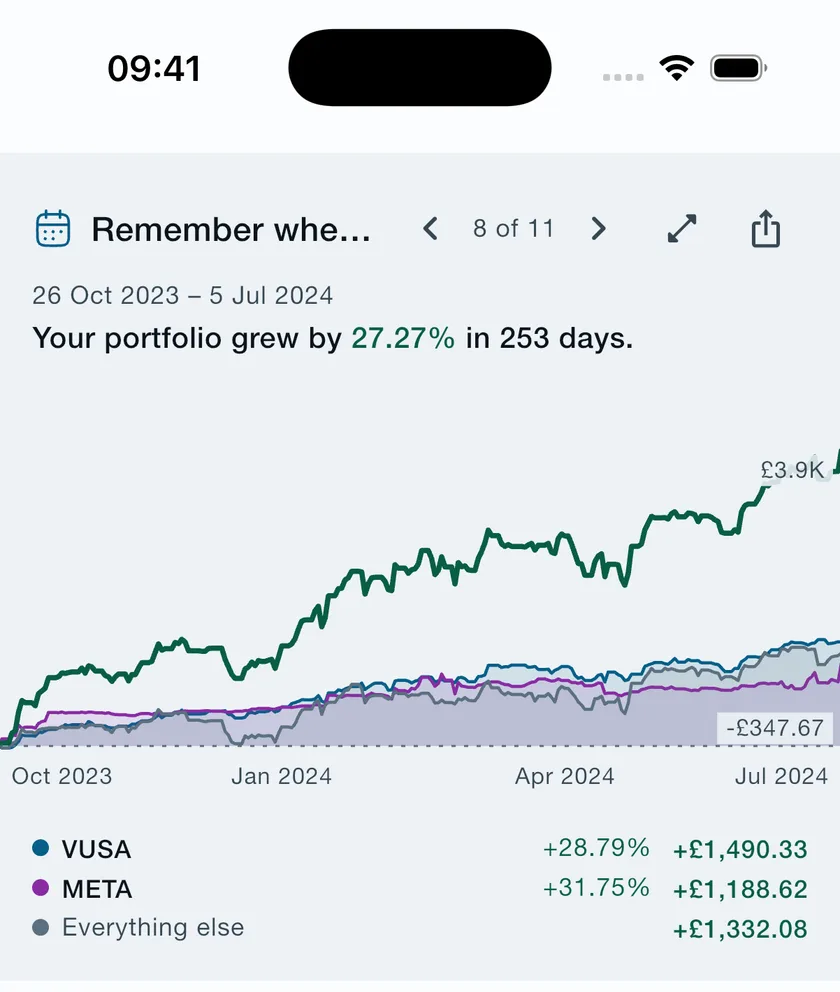
A profit line has moments in it
Once profit is measured properly it stops being a single number and becomes a line with a shape: stretches where it climbed, stretches where it fell, and the crossings back to where it started. The app reads that line for its turning points and ranks what it finds, so the best and worst stretches of your history surface on their own — this is the eighth of the eleven the card is holding, and how many it holds depends on how long your history is.
This is where the deposit rule earns its keep. Because the line already nets out money you paid in, a month of transfers cannot register as drama — every moment on the card is something the portfolio did, not something you did to it.
Each one states a fact the database can compute exactly, and where a holding actually carried the run it is named with its own figure. The parts are not claimed to add up to the whole, because dividends, interest, fees and currency moves are in that line too.
Frequently asked questions
What is the difference between realised and unrealised profit?
Realised profit is locked in by a sale — you sold, and the result is settled. Unrealised profit is what your open positions are up or down at the moment, and it moves every day. Adding them together gives your lifetime figure; keeping them apart tells you how much of it you have actually banked.
Does depositing money increase my return?
No, and a return that says otherwise is broken. Paying money in makes your portfolio bigger, not better. A time-weighted return treats a deposit as an external flow contributing exactly nothing on the day it arrives, which is what lets you compare your performance with an index at all.
Are fees subtracted from my profit?
They already are, once. Trading 212 exports a total that the charge has come out of, so your profit reflects fees without anything being deducted a second time. What is worth doing separately is adding those charges up, so you can see what they came to across your whole history.
Do dividends count towards performance?
In the time-weighted return, yes — dividends and interest are money the portfolio earned, so they belong in it. In the lifetime profit and loss figure they are not folded in: that number is realised and unrealised gains, and each asset states its total including dividends separately. Deposits and withdrawals are money you moved, so they count towards neither. Currency conversions are neither — they are the same money in a different denomination.
What happens if a price is missing?
The figure is treated as unknown rather than zero. A holding that cannot be priced is counted and named rather than silently added in at nothing, because a total that quietly omits a position is worse than a total that tells you it is incomplete.
Get the long answer to a short question.
Import your history and see the number with its working shown.
Portfolio tracker
Every position you have ever held, the shape of the book as a heat map, and any past date you like.
Read more →Fee tracker
What every charge actually cost you — per asset, per charge, since your first trade.
Read more →Dividend tracker
Every dividend and interest payment on the record, per holding and lifetime.
Read more →